Showing posts with label Japanese Folktales. Show all posts

Tuesday, March 06, 2007

The Elves and The Envious Neighbour - Japanese Folktale

Once upon a time a man was traveling back to his village from a long day at a local market. He was late and unfortunately found himself in the middle of the forest when the sun set.

Being nervous of walking at night, he found a hollow in a big tree by the track and snuggled in for the night. He slept lightly as he was unused to sleeping with the sounds of the night so close and the ground seamed to itch him so that he fidgeted under his kimono.

As time wore on into the blackest part of the night he began to drift into the restful part of dreaming, however just as he was to slip into unconsciousness a noise caught his attention. He thought he had heard a voice. Then he heard another. And then more voices. He was wide awake now and very frightened. "Who could it be carousing through the forest in the middle of the night?" he thought.

He peeped out of the hole in the tree and saw a gang of elves had set up a party next to his tree by the track and were bringing out bottles of sake and food. They danced and sang in the most amusing way and so that after a while he forgot all about his fear and crept out of his hole and took his turn at the sake cup and sang and played with the elves of the forest.

The next morning just before the sun broke the night into day, the elves congratulated the man on his inspired drinking games and for teaching them new songs and dances. Hoping to have him return, and being elves and so by nature tricksters, they took what they thought to be something precious to the man in order to secure his return. What they took however was a big red wen that had been an embarrassing birth mark on his head. The man couldn't believe his luck at being so transformed!

When he arrived in his village, his changed appearance caused quite a deal of interest and soon a large circle of people gathered around his front door to hear his remarkable tale. His neighbour seemed particularly keen and remained to hear the tale told many times. He even asked very particular questions like just exactly which tree he had stopped at and asked if he would be able to judge what time it was that the elves appeared. This was all very curious but after a while everyone went back to their homes and got on with their business. All, except the neighbour that is. He went back to his house and prepared a travel pack. When all was quite, he slipped out of the village and into the forest to find the elves.

Now, why in heaven would he do such a thing? Well, you see he also had a red wen on his head and he thought that if he dined and supped with the elves that they would take his wen too.

He hid in the hollow of the tree that had been described and he waited until the very dead of night. The elves came and began their nightly revel and so, even though he was white with fear, he crept forward taking the sake cup handed to him by one of the frightful elves. In the morning the elves thanked their guest for coming back to play with them. You see, they had mistaken the neighbour for the man of the night before. "Since you have been so good to return to us as you promised, we will return to you the treasure we took last night," said the head elf. The neighbour was at a loss as to what treasure they meant as the man had not mentioned any treasure in his tale, but the neighbour replied he was eager for his treasure to be returned. Suddenly, the elves disappeared as the sun had broken the spell of night and the neighbour found himself confused and alone without the promised treasure, or so he thought.

He stumbled back to the village disappointed, with a heavy head and a blurry eye. As he walked passed the people of his village, they all started to stare at him in the most peculiar way and some even started laughing behind their sleeves. "What could all this mean?" he thought. When people began to point at his head and run to get others, he decided to see for himself what was the matter with him. He leaned over the edge of a duck pond that was close by and gasped at what he saw. His wen had grown to twice its size! Now, he knew that the treasure was the wen of his neighbour and the elves had kept their devilish promise. He cried out loud and fled home to his house. He did not come out for a very long time.


********


The Elves and The Envious Neighbour has been adapted from the tale of that name from the book, "Tales of Old Japan", by A.B. Mitford, Wordsworth Editions, London, 2000. ISBN 1 84022 510 6

This is a very funny story and when I came across the Kyogen mask with the wen (wen is a benign tumor of the skin) I knew I had to adapt this tale for Crackle Mountain.

Images:

Image 1: Oni in a tug of War, attributed to Hasegawaw Mitsunobu, from "Toba-e fude byoshi" (Comic Pictures in Rhythmic Brushplay. 1772) Vol. 2. Woodblock printed book, 25.4 x 18 cm. This is image has been scanned from the book "", Edited by Stephen Addiss, George Braziller, New York, 1985, in association with the Spenser Museum of Art, University of Kansas.

Image 2: Japanese Kyogen Mask, from Masks of the World.

Image 3: Noh Mask; Humans and Fox Netsuki, unknown artist, ivory with inlay, height 5.1 cm. Spenser Museum of Art: William Bridges Thayer Memorial, 28.355. Scanned from the book "Japanese Ghosts and Demons: The Art of the Supernatural", Edited by Stephen Addiss, George Braziller, New York, 1985, in association with the Spenser Museum of Art, University of Kansas.

Wednesday, August 16, 2006

The Fire Quest - Japanese Folktale

The old poet sat alone by the light of his lamp. It was a beautiful, clear, full moon night of the seventh month. The stars twinkled brightly upon the indigo sky, the cicala whirred and the frogs sang to each other in courtship across the pond. Though the flowers of night lulled all creatures with their sweet scent, the poet was concerned, for hundreds of little moths flung themselves upon his flame; nor was it only the moths but also the brilliant dragonflies and cockchafers that brought themselves towards the flame on the Fire Quest. But all in vain - each one, as it sort its prize, was burnt and so died.

Scooping them up, he let out a deep sigh and spoke to those still spinning near his lamp, "Little ones it saddens me so to see you perish by my side. Will not any of you leave off the Fire Quest? "
He leaned in towards them to inquire, but they gave him no notice.
"The Fire Quest was begun so long ago, perhaps you have forgotten its meaning. Listen and I will remind you:


"Long ago, on a night much like this one, there lived the Firefly Queen. She was the most beautiful of all the little creatures of the air. Her rosy palace was the magnificent Lotus of the Lake. Bright was her palace and as it nodded above the water it was like a star reflected in its mirror.

"To this star all the creatures of the air came to win the hand of the Firefly Queen. Their passion drove them to her and nothing could persuade them to depart. 'Please have pity on us, Queen of the Stars, Brightess Flame of the Lake,' they cried. However, the Firefly Queen, not being sensible to her powers of love, was perplexed by the swarm that crowded by her palace. She gave them no answer, but still the suitors sent petitions of their love.

"After seeking advice, she finally appeared before her admirers; in a swoon they listened to her proclamation. 'You suitors who seek my hand,' she spoke. 'Shall prove to me thy love by bringing to me the Light of Fire.' From within the palace could be heard the sounds of laughter. Why laughter? I will tell you soon enough. But the Queen had spoken, oh the foolish little ones, they left the Lotus Palace in search of the Light of Fire, and it became known as the Fire Quest.

"Flung out into the night, driven by their desires, they flew. Taking the fast currents of the air they found openings in lattice opened with the warm weather. Seeking the Light of Fire they flew into the chamber of a young girl in tears, a love letter opened upon her pillow. Onwards they flew and found another sitting at a mirror, holding up a lamp as she painted her face. The powered, white wings of a moth put out her flame.'Oh! The terrible dark!' Exclaimed the woman in shock and surprise.

"In other place an old man lay dying. 'Light the lamp for me, the night has come and I cannot see.' He tried raising himself in bed but his family helped him back to his pillow. 'The lamp has been lit for some time, Father. By your bed it stands and the enumerable moths and dragonflies that fly around it are making quite a din.' The dying man sort his son's hand and whispered, 'I know nothing at all.'

"The next morning all those who had flown on the Fire Quest where swept away. All had burnt their wings upon the flame and died.

"The Firefly Queen lay safe in her lotus, wrapped in the arms of her beloved. He had already won the Fire Quest, for he was the Lord of the Fireflies and so carried the Light of Fire within his body - never to be burned by its light. It was he, who had concocted the vain plan to send the suitors away upon the Fire Quest, and he who had laughed that night when it all began.


"So you see, my little delicate friends of the air, you have been deceived. Your love of the Firefly Queen may be unquenchable but no longer need you seek the Light of Fire."

But the Dragonflies and the cockchafers and the moths still swung wildly about his lamp, heeding not the sage advice of the poet. One by one they grasped the flame in fulfillment of the Quest and fell dead upon the floor.

The wise poet sighed again at their folly, and blew out his lamp. "I will sit in the dark," he said; "it is all I can do."


Details:

The Fire Quest has been adapted from the book Green Willow and other Japanese Fairy Tales, by Grace James, Macmillan, London, 1979. (first published 1923).

The translation of this story in Green Willow is very charming. It touched my heart when I read it. While I couldn't keep much of the quaint language the Green Willow adaption uses, I did decide to keep the word "cockchafers" instead of the modern cockroach. I liked the word cockchafer better as, apart from its poetic sound, it reminds one that all insects are worthy beings even ones that make us cringe.

The first picture is not a picture of a scholar or poet and is not of Japanese origin. It is a Chinese sculpture of a Lohan - a person who has obtained a level of spiritual attainment similar to that of a bodhisattva. When I came across this sculpture he immediately conveyed a sense of thoughtfulness and compassion and I knew I had found my 'poet'. A link for more detail on the piece will follow in the images section.

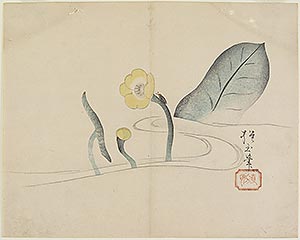
Interestingly, the humble picture that begins the details section was the reason for my choosing this tale. Its called Lotus and a Gold Bug and that tiny black bug climbing the flowers stem is the Gold Bug or firefly as we know it. I was surprised to learn that this is how a firefly looks. Oh! That this little thing had caused such a stir....it is always the way.

Images:

1. Lohan as an Ascetic, Anonymous - Chinese, China Yuan Dynasty 1260 - 1368, wood sculpture, wood with pigment and gold, h. 28.0 cm. Princeton University Asian Art Collection.

2. Clouds of Flowers from Jogaku sekai - Postcard, Ikeda Shoen (Japanese, 1886 - 1917), Late Meiji era, 1906, 8.8 x 13.8 cm, Color lithograph; ink on card stock. Leonard A. Lauder Collection of Japanese Postcards, Museum of Fine Arts, Boston.

3.Kotatsu, Ito Shinsui, Published by Shozaburo Watanabe, January 1923, colour woodblock print, image dimensions 40.96 x 24.29 cm, Minneapolis Institute of Arts: Arts of Asia Collection.

4. Four-case Inro with insect design, Japanese, Edo Period, Mid-late 18th century, Shiomi School style. William Sturgis Bigelow Collection, Museum of Fine Arts, Boston.

5. Eight Views of Omi: Ishiyamadera -1917, Ito Shinsui (1898 - 1972). Aiban tate-e, 31.5 x 22 cm. I found this image at Scholten Japanese Art in their online gallery exhibition. If you click on the link for the image, go to the 'continue to the exhibition' section then click forward 3 images and it is the fourth. This is a selling site, nice looking with high quality work. The Gallery appears in a pop up window that I couldn't link to directly.

6. Lotus and a Gold Bug, Hogyoku Yamada, c 1830. Colour woodblock print - Japan, 23.4 x 29.4 cm. Minneapolis Institute of Arts: Arts of Asia Collection.


Wednesday, June 28, 2006

Tamamo - The Fox Maiden (Folktale, Japan)

"I've been waiting for you for over a hundred years," sighed the young girl by the side of the road. A passing peddler paused to scratch his head, eyed the pretty girl, then laughed at the cryptic remark.

"Why don't you come to Kyoto with me then, if that's the case," he called. "I'll be selling my wares at the Emperor's Court, perhaps we might find something for you there."

So on they traveled together for many days along the Tokaido roadway to Kyoto. Traveling day and night, he marveled that she was never tired or afraid.
In Kyoto, the peddler sold his fine wares to the ladies of the court. Amidst their merriment one lady remarked on the graceful appearance of the young girl and asked her to entertain them with some dancing. The young girl obliged them with the most elegant performance they had ever seen. So delighted were the ladies that the Emperor himself called for a special performance of the dance. And so she danced again and to His Augustness it seemed as if she was the foam upon the waves.

"Tell me", asked the Emperor,"what favour can I grant you in return for this beautiful gift?"
The girl was silent with eyes averted as if she were overwhelmed.
"Do not be afraid, ask of me anything at all."
"Anything?" ventured the girl in a small voice.
"Of course, please just ask."
"Then...if it pleases you... let me stay here in the residence of Your Radiance."
And so it was that the girl was accepted into the Emperor's household.

Within a few years the girl grew into the most refined of ladies, accomplished in every lovely art; at the koto there was none to match her sensitive touch, the tracings of her brush were cherished and kept in sandalwood boxes, her knowledge of the Classics was enviable. There was not one art that escaped her perfection. She became known as the Jewel without Flaw - and the Emperor's favourite.

As the years past the Emperors temper became increasingly strange, listless at times more querulous at others till the state of the court was nervous and brittle. But still he would favour Tamamo and became bright and gay while she was with him. So careless did he become that for the occasion of her thirty-seventh year he commanded a great banquet to be held in the Summer Palace in her honour. His wise councilors advised him of the dangers of such an inauspicious occasion, but the Emperor heeded them not sending them violently away.

Gathered together the whole court proceeded to dine and feast, wine cup after wine cup. Giddy with pleasure the Emperor openly declared, "Tamamo, there's not a woman in the world who is fit to touch your sleeve!" At that very moment there was a clap of horrendous thunder so loud that it pierced the ear - the Emperor collapsed as one struck by lightening! Black boiling clouds rose up out of nowhere and the day became as night. The Court was panic stricken, ladies screamed and men ran pell mell over tipping the feast and up turning furniture. The red and gold clad Tamamo was as an unearthly statue and from her body their came a ghostly fire.

The Emperor remained as one asleep from that time and the wise men of the Court were very worried. They decided that they should call on the assistance of Abe Yasu, the Diviner.

"Please help us!" they supplicated. "You who have knowledge of the secret ways must help us find the cause and cure of this strange stupor." And so he did, Abe Yasu performed the rites of divination. Returning to them the Diviner said:

" Merry wine sinks with a leaden head.
Bright fruit, bitter taste.
The Peony disguises the Death Lily,
confusion in its scent.
Vices are illusions web; deception wears desire's mask."

"What can that mean?" the wise men questioned Abe Yasu. "Please explain the meaning of what you say for we are in sorry need of aid."
"I will help you but first I must fast for three days, return to me then and we will save His Augustness."
When the wise men returned they found Abe waiting for them. The Diviner took the Sacred Gohei from its place in the Shrine - blessing each of them with a touch of the Gohei.

Abe Yasu and the wise men proceeded to the Palace and asked for an audience with Tamamo. Tamamo was in her bower with her maidens.
"What could they want with me?" she asked the attendant who delivered the message.
"They wish you to here a poem, My Lady."
"It is a strange time for poetry, tell them to go away."

But the wise men and the Diviner insisted saying they would not leave until she had given them an audience. So she finally consented and Abe Yasu coming forward spoke to Tamamo though the screen.
"My Lady please come a bit closer, I am an old man and my voice is feeble." Tamamo drew very near to the curtain so that her fair hand revealed itself.
"What is this poem you speak of?"
"I will tell it to you:

Merry wine sinks with a leaden head.
Bright fruit, bitter taste.
The Peony disguises the Death Lily,
confusion in its scent.
Vices are illusions web; deception wears desire's mask."

And with that he touched the Scared Gohei to Tamamo's hand. Her hand withdrew with a terrible cry of pain. The curtains blew out and a golden fox with nine tails flew out from the bower and away.

Far, far it few until it came to the plain of Nasu, where it hid itself beneath a large black stone that stood in the plain.

The Emperor was said to have recovered the very day Tamamo disappeared.

There soon came stories of the Black Stone on Nasu plain; that there flowed from it a poison steam, any who drank from it whether bird, beast or man, sickened and died. People were said to have passed away just from sitting in its shade and birds flying over the stone were said to have dropped from the sky. It became know as the Black Stone of Death for over a hundred years.

The wheel of fate turned and so it was that a High Priest named Genyo - a special holy man, was traveling through Nasu on a pilgrimage. The villagers kindly filled his begging bowl with rice and vegetarian food. They also warned him of the Black Stone of Death.
"Do not rest near the Black Stone," they said. "For its poison is ancient and evil."
The priest thoughtfully thanked the villagers for their care but reminded them, "the Book of the Good Law tells us that even the herbs, trees and rocks shall enter into Nirvana."
Instead of avoiding the Stone, Genyo made his way towards it. On arriving there he set up incense and recited scriptures. After many hours when the sun was dipping low on the western horizon Genyo picked up his staff, striking the Black Stone he cried, "Spirit of the Black Stone of Death, Come out!"

A great fire blazed forth from the stone as it split through its middle with a great howling sound. Then all was quite and before the Priest there stood an old woman, her eyes full of tears. She said:
"I am Tamamo, once called the Jewel without Flaw. I am the golden fox spirit, who has lived for over two thousand years. I have the knowledge of all magic and I have been worshiped by nations and by men. But love has changed me and I have passed these hundred years weeping in bitter grief. Please holy man strike me down so that I may be eased of this terrible pain."

"No, poor spirit, I shall not kill you." Genyo removed his priests robes and wrapped them around the fox spirit. He gave her his begging bowl and his prayer beads saying, "go instead upon the long journey of enlightenment."
Tamamo gave a small wan smile before vanishing never to be seen of again.
Genyo lit more incense. Praying for the fox spirit, he said:

"O Buddha Tathagata and merciful Bodhisattva Kwannon, may she be reborn upon the path of Devotion."


Details:

Japan and China have a significant body of folklore concerning the fox - kitsune in Japanese. If you would like to know more, the information on kitsune from wikipedia is quite excellent, click here. The Kitsune Page is a good source for more foxlore too.

"What's a Gohei?" I hear you ask. Not an easy one to translate into Western thought, so once again wikipedia has a little something to give you a basic picture, click here for an image. The information on wikipedia for gohei is very slim, I thought the image of one might be of more imaginative help.

This story has been adapted from the book, Green Willow and other Japanese Fairy Tales by Grace James, Macmillan and Co., London, 1923 (this edition 1979), ISBN 0 333 27390 7.
This book belongs to the collection of my friend Susan K. It was given to her as a gift by a friend, it is a beautiful fabric hardcover with charming watercolour illustrations by Warwick Goble. Unfortunately I'll have to return it soon, as she is going to Shanghai for an arts administration residency in September. I wish her luck and as thanks dedicate this story to her.


Image 1: Japanese Mitsuore Ningyo of a Girl, a jointed Costume Doll. Standing 10-1/2" High. Meiji Period, Circa 1870. Image taken from the ningyo page on L'asie Exotique. I have added this site to my Web Links section as their collections are very good - worth a look.

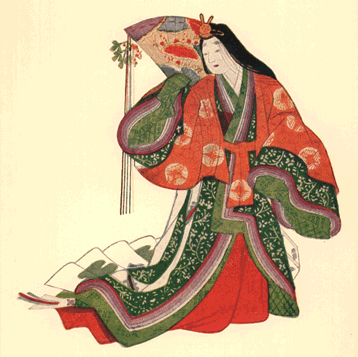
Image 2: Court Lady in full dress from the Heian Period from Kokushi Daijiten. Image taken from Dairies of Court Ladies of Old Japan, digital version found here.

Image 3: Court Ladies, Kuchi-e, Eisen Tomioka (1864-1905), woodblock print circa 1900-1910. Taken from Artelino Auctions.

Image 4: Nine Tail fox, artist unknown. Image taken from The Kitsune image page.

Image 5: Old Nun, Tong Zhenguo(?), taken from Chinese literature: Fiction, Poetry, Art, Summer 1986. Beijing, China. The Old Nun is a powerful image - when I saw it I immediately thought of this story. The image is Chinese and the story Japanese, however the art of Sumi-e (ink painting), as the Japanese call it, is a tradition of both countries so I felt it was still within the right vein.

Image 6: Fox as Nun, Artist unknown, 18th century. Netsuki, ivory, height 7cm. Collection of Dr. and Mrs. George A. Colom. Taken from the book Japanese Ghosts and Demons: Art of the Supernatural,Steven Addiss, George Braziller Inc., New York,1985. ISBN 0-8076-1126-3


Friday, May 12, 2006

Crackle Mountain: folktale, Japan.


Once upon a time there lived an old woodcutter and his wife, and their beloved pet Hare. They were poor but managed a simple and happy existance by living close to the deep forest where the old man collected wood.

Everyday the gentle woodcutter would leave food out for the Hare's breakfast before the woodcutter went off to work. One morning along came a mischievous Tanuki, who was passing though the neighbourhood. Seeing this yummy food, he fell to eating it until not a morsel remained for the Hare.

"Hey! You there! That's not for you," cried the woodcutter spying the thief. He snatched up the Tanuki, bound his legs and hung him from a high beam. Thinking that it was now late, the old man picked up his basket and hurried off into the forrest to collect the wood that kept body and soul together.

Now, this was not the kind of treatment the Tanuki was used to. Inside he was very, very mad, but Tanuki are very sneaky and so when the old woman came outside to start cooking the evening meal the crafty Tanuki, wept and sighed. The old woman was moved by his tears and with a tender heart cut the Tanuki down and freed him from his bonds. You might have thought that one would be grateful, but no! The Tanuki was as spiteful as snake's blood and to revenge himself upon the old man, he knocked the old woman on the head when her back was turned. He skinned her and cooked her up in the cooking pot!!!

When the dear old woodcutter returned there stood his beloved wife with a steaming bowl of stew ready for him on the table, yum. He was very hungry from working all day without lunch. He slurped down the very tasty stew, licked his lips and praised his wife for such a delicious meal. But to his surprise his wife's shape began to shimmer - blinking, he saw to his horror that it wasn't his wife at all, but that wretched Tanuki! Ah, what had happen to his wife? The Tanuki was laughing and pointing at the soup. "Old man," he squealed, "you ate her up, you ate your wife!" The old man reeling backwards fell from his seat and fainted into unconsciousness.

Oh, what a rotten Tanuki this was.

The Hare had come home late from a visit to his relatives and had entered the house just in time to see this monsterous scene. Hanging back in the shadows to avoid being seen, the Hare resolved to revenge his family. He followed the Tanuki for days, studying his habits and ways. And, being quite clever himself, hatched a cunning plan to become the Tanuki's traveling companion.

One day when the Tanuki had gathered on his back some firewood for cooking, the Hare secretly set it alight. The kindling cracked and popped as it started to burn. "My word!", exclaimed the Tanuki, "what's that sharp sound?" To this, "Oh!" answered the Hare, "this is called Crackle Mountain. There is always this noise here." Much comforted by his friend's explaination the Tanuki walked on, curiously listening to the hissing and crackling. All of a sudden the Tanuki's back got very hot and, "Owieeeee!!!" he yelled. His back was burning, his fur smoked and his skin was blacked and curled. The Hare had got his first taste of revenge.

The Tanuki was very badly injured and so the pair holed up for a while in a small cave. The Hare played the part of the caring friend and promised the Tanuki a special poultice that would easy his pain. The hare left for a near by village to get supplies for the poultice. When he return he was carrying a red bag ready to be applied to the raw flesh of the wounded Tanuki. Desparate to relieve his pain the Tanuki grabbed the bag out of Hare's paw and quickly layed it on his own back. "Ahooooooiiiiiieeeeee!" cried the Tanuki. The Hare had filled the bag with Cayenne pepper to trick his hated companion.

After this the Hare moved down to the seaside, which was close by the cave, until the Tanuki recovered. After many months of pain and suffering the Tanuki was well enough to leave the cave. He wandered down to the water's edge to complain to his friend for mixing up the poultice with pepper, when he noticed that Hare was building a boat. "Where are you going with that," he asked the Hare. "I'm building this boat to row to the City on the Moon." The greedy Tanuki had heard of the wounderous City on the Moon and his eyes grew feverishly round. "I too will build a boat to row to the City on the Moon." And so the Tanuki fashioned a boat for himself, however, being unskilled in carpentry as the clever Hare was, he moulded his boat out of the clay he dug from the cave.

When the boats were completed and the tide swelled with the night of the full moon, the Hare and the Tanuki lauched themselves upon the waves. The Hare pulled on his oars, and the Tanuki strained with all his muscle against the sea. Their boats shot out into the deep waters, where the loud groans of the gaint Sea Dragons could be heard in their underwater palaces. It was here, were the water was blackest, that the Tanuki's clay boat begun to break and crumble. "Help me!" pleaded the Tanuki, "Help me Friend!" But the Hare had a stern look in his eye. "Help me!" cried the Tanuki again, clawing the side of the boat trying to grab hold of Hare's oar. The Hare snatched it away and brought it down hard upon the clay boat, smashing it with a single blow. The terrified Tanuki fell backwards with a crash, and plunged into the water with the remains of his boat. The cold sea swallowed him up and his malefic spirit was chained to the bottom of the ocean by the Dragon's scaley minions.

The Hare having lost the family he loved rowed on towards the City on the Moon.

********

Tanuki is a raccoon-like dog often mistakenly referred to as a badger. The Tanuki is a trickster spirit from Japanese folklore - often mischievous but can sometimes be helpful.

Images:

1. Noh maskes, Okina (Old Man) and Uba (Old woman) taken from www.nomask.com

2. Tanuki and Rabbit by Kita Busei (1776-1856), 1831. Woodblock print, surimomo, 20.2 x 18.2 cm. Spencer Museum of Art: William Bridges Thayer Memorial, 28.355. Taken from the book, Japanese Ghosts and Demons, ISBN 0-8076-1126-3

3. Image taken from Tales of Old Japan, A.B. Mitford, Wordworth Editions reprinting, 2000. ISBN 1-84022-510-6

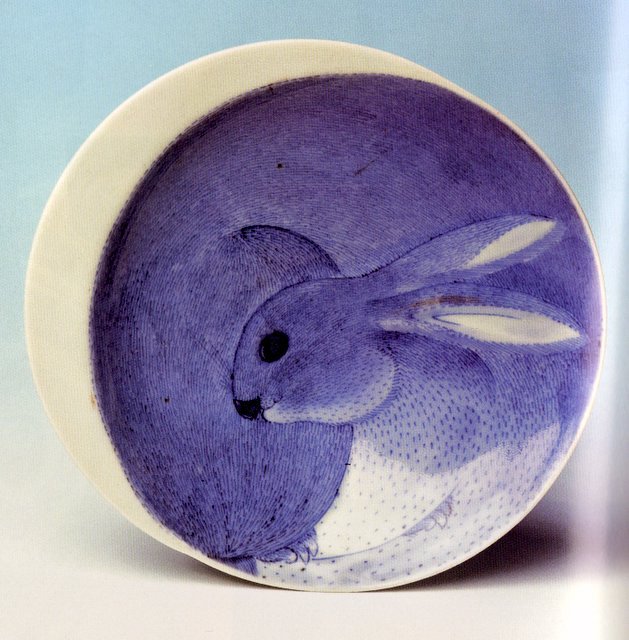
4. High Footed, Moulded dish with hare, moon and waves, Nabeshima ware. Porcelain with underglaze colbalt-blue. Circa 1700-1720 CE. Height 3cm, diameter 14.5cm. The Bristish Museum, London, Franks 1292. Image from Arts of Asia (magazine) Volume 34 Number1.